
Updated 26 October 2026. The Brazilian real collapsed at Monday’s open after President Luiz Inácio Lula da Silva won Sunday’s runoff. The commercial dollar opened 8.65 percent higher at R$5.425 and reached R$5.605 (+12.25 percent) by 9:47 am Brasília time, from R$4.993 on Friday (InfoMoney). Ibovespa futures fell as much as 19.7 percent, and the cash market hit a circuit breaker minutes after its 10:00 am open (Money Times). Verdict: this is a repricing of a result markets had not expected, not a panic over the vote itself. Polymarket gave Flávio Bolsonaro about 80 percent going into the weekend. Reference levels for USD/BRL: R$5.20 if the real recovers, R$6.00 if it keeps falling.
Key facts
- The result: Lula won 51.79 percent of valid votes to Flávio Bolsonaro’s 48.21 percent, according to the electoral court TSE, a margin of about 4.4 million votes (Rio Times, InfoMoney). Flávio said he does not recognise the result and will ask the electoral courts to annul the runoff (InfoMoney, Money Times).
- The real: the commercial dollar closed Friday at R$4.993. It opened at R$5.425 (+8.65 percent) at 9:09 am, traded R$5.523 (+10.69 percent) at 9:36 am and R$5.605 (+12.25 percent) at 9:47 am Brasília time. November dollar futures traded R$5.610 (+12.78 percent) at 9:43 am (InfoMoney). Real futures had already fallen about 10 percent in Asian trading overnight.
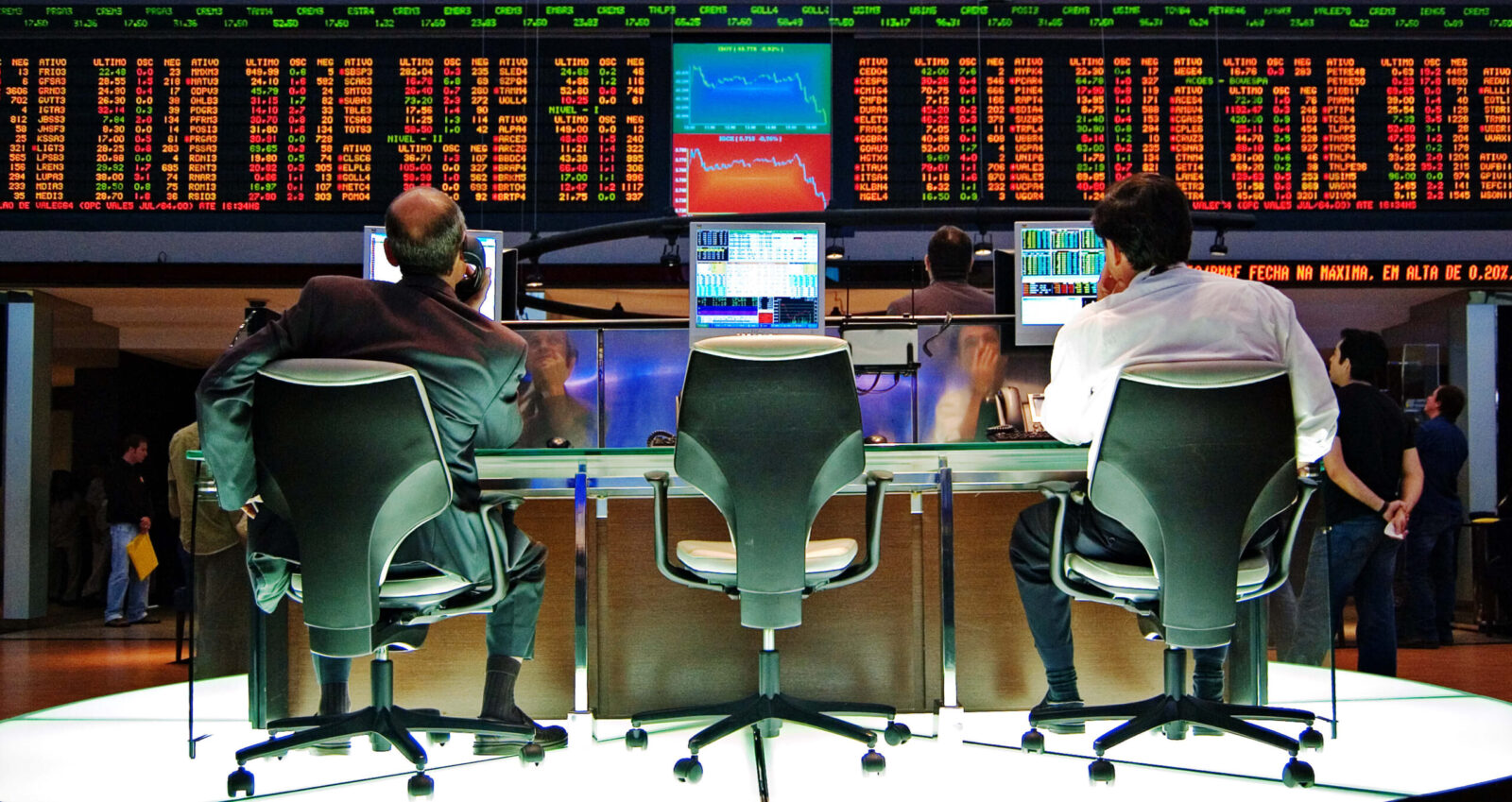
- Stocks: the Ibovespa closed Friday at 205,082.56 points. Ibovespa futures opened 14.84 percent lower at 177,215 points at 9:04 am, touched 167,095 (-19.70 percent) at 9:40 am and stood at 170,920 (-17.73 percent) at 9:52 am (InfoMoney). B3 suspended cash trading under its circuit breaker at 10:03 am (Money Times); the rule halts trading for 30 minutes when the index falls 10 percent. Seu Dinheiro notes that a circuit breaker has never before followed an election result.
- Emergency limits: for Monday only, B3 widened the daily limit on Ibovespa futures from 10 percent to 15 percent and then to 20 percent, and on dollar futures from 6 percent to 8.4 percent and then 12 percent (InfoMoney, Money Times).
- Rates: DI interest-rate futures hit their daily limits at the open. At 9:33 am the January 2028 contract was at 14.295 percent (+1.47 points) and January 2035 at 14.585 percent (+1.93 points) (InfoMoney). The National Treasury cancelled its bond auctions scheduled for 27 and 29 October.
- New York premarket: the iShares MSCI Brazil ETF (EWZ) was down 25.79 percent at 7:59 am and 27.46 percent at 9:39 am Brasília time; Petrobras, Itaú Unibanco and Bradesco ADRs were all down more than 20 percent (InfoMoney).
- Analysts: JPMorgan’s Vinicius Moreira and team cut the real and local government bonds from overweight to marketweight, expecting domestic cyclicals to suffer and exporters to outperform. Gavekal Research’s Rohan Daswani recommended buying Brazilian assets after the sell-off, arguing the high-rates and commodities case still holds. Leonardo Mendes of Manchester Investimentos said the market is repricing fiscal and institutional risk at the same time (all via InfoMoney).
Why a 51-49 result moved the real 12 percent
The vote was close; the market’s positioning was not. Flávio Bolsonaro won the first round on 4 October, and investors spent three weeks pricing a government that would cut spending quickly. Five days before the runoff, Polymarket priced Flávio at about 80 percent and Kalshi at about 79 percent, while the polling average sat near 51-49. When the count went the other way, the real, Brazilian bonds and the Ibovespa all had to reprice at once, which is why the move looks more like a devaluation than an election-night wobble.
The rates market shows the real fear. Long-dated DI futures rose almost two percentage points in minutes, to above 14.5 percent, which prices fiscal risk years ahead, not just Monday’s mood. The Treasury cancelling two auctions says the government did not want to sell debt into that. The question Leonardo Mendes raised is the one the currency will trade on: whether Lula’s team sends a credible fiscal signal in the next few days.
The legal challenge and the central bank
Flávio Bolsonaro’s refusal to recognise the result adds an institutional question to the fiscal one. Brazil’s electoral courts certified the 2022 result over a similar challenge, and China congratulated Lula on Monday morning, but until the TSE rules the challenge keeps a risk premium in Brazilian assets. Separately, traders quoted by Money Times expect the Banco Central do Brasil to intervene by selling dollars in the spot market; that is a market expectation, not an announced decision. Intervention, or swap auctions, would be the first test of whether R$5.60 holds.
What it means outside Brazil
EWZ’s premarket fall of more than 25 percent will show up in US-listed emerging-market funds and in Petrobras, whose ADRs fell more than 20 percent even with oil high: Brent started the week near $114.60 after the Houthi claims on Yanbu. Investors’ concern is state intervention in state-controlled companies, not the oil price. Crypto users in Brazil, who already face Binance’s service restrictions under the new crypto rules, tend to move into dollar stablecoins when the real falls; local exchange data for Monday was not yet available.
USD/BRL from here: three paths
| Scenario | USD/BRL | What has to happen | Anchor |
|---|---|---|---|
| Real recovers | R$5.20 | The central bank sells dollars or runs swap auctions, Lula’s team names a fiscal anchor this week, and the TSE dismisses the challenge quickly. Gavekal-style buyers step in. | About 7 percent below Monday’s R$5.605 high, still 4 percent above Friday’s R$4.993. |
| Base | R$5.40-5.60 | Volatility stays high while the market waits for the economic team and the court ruling; no further shock. | Between Monday’s R$5.425 open and the R$5.605 peak. |
| Real weakens further | R$6.00 | No fiscal signal, the legal challenge drags on, and foreign funds keep selling after JPMorgan-style downgrades; DI rates keep rising. | About 7 percent above the R$5.605 peak; 20 percent above Friday’s close. |
What to watch this week
- Monday: where the Ibovespa settles after the circuit breaker, whether a second halt is triggered, and the close of the commercial dollar.
- Central bank: any spot dollar sales or extra currency swap auctions from the Banco Central do Brasil.
- Government: the first statements from Lula and his economic team on the 2027 budget and fiscal rules.
- TSE: the court’s handling of Flávio Bolsonaro’s request to annul the runoff.
- Wednesday 28 October: the US Federal Reserve decision, which sets the dollar’s direction against every emerging-market currency.
Quick take: Lula’s 51.79 percent win caught markets positioned for Flávio Bolsonaro, whom Polymarket had at about 80 percent. The dollar jumped as much as 12.25 percent to R$5.605, Ibovespa futures fell up to 19.7 percent, and B3 halted cash trading. A fiscal signal and central bank intervention would open R$5.20; a drawn-out legal fight and no budget anchor open R$6.00.
FAQ
Who won Brazil’s presidential runoff?
Luiz Inácio Lula da Silva won the 25 October 2026 runoff with 51.79 percent of valid votes against 48.21 percent for Flávio Bolsonaro, according to the TSE. Flávio has said he will ask the courts to annul the result.
How much did the Brazilian real fall?
The commercial dollar rose from R$4.993 on Friday to R$5.425 at Monday’s open (+8.65 percent) and R$5.605 (+12.25 percent) by 9:47 am Brasília time, a fall of roughly 11 percent in the real’s value (InfoMoney).
Was there a circuit breaker on the Brazilian stock market?
Yes. B3 suspended cash trading under its circuit breaker at 10:03 am Brasília time on 26 October, after Ibovespa futures had fallen as much as 19.7 percent (Money Times, InfoMoney). The rule pauses trading for 30 minutes after a 10 percent fall and one hour after a 15 percent fall.
Why did markets fall after Lula’s win?
Investors had positioned for a Flávio Bolsonaro government and faster spending cuts; prediction markets gave him about 80 percent. Lula’s win forced a repricing of fiscal risk, visible in DI rates rising almost two points on long maturities.
How did EWZ react to the Brazil election?
The iShares MSCI Brazil ETF was down between 25.6 and 27.5 percent in US premarket trading on Monday morning, and Petrobras, Itaú and Bradesco ADRs were down more than 20 percent (InfoMoney).
What could make the real recover?
Central bank intervention, a clear fiscal anchor from Lula’s economic team and a quick court ruling on the challenge. Without them, the R$6.00 level is the next reference for USD/BRL.
Sources: InfoMoney live coverage, 26 October 2026 (dollar, Ibovespa futures, DI futures, B3 limits, EWZ and ADRs, analyst comments, timestamps in Brasília time); Money Times live coverage, 26 October 2026 (circuit breaker at 10:03 am, Treasury auctions, China statement, intervention expectations); Rio Times (TSE vote count and margin); Seu Dinheiro (circuit breaker history); FinanceFeeds, 21 October 2026 (Polymarket and Kalshi odds).
Disclaimer: This article is for informational purposes only and does not constitute financial or investment advice. Currency and stock markets are highly volatile, especially after elections. Do your own research and consult a licensed financial adviser before making investment decisions.